Do you ever feel like the ground is shifting beneath your feet every time you check your website analytics? You are not alone. In 2026, the digital landscape has changed a lot, making many marketers wonder how to stay seen in a world ruled by AI.
It’s no longer optional to understand the shift from old search methods to new AI-driven ones. This is the key to keeping a competitive edge in the U.S. market. We need to mix classic search ways with the rise of seo-vs-geo-generative-engine-optimization strategies to really connect with our audience.
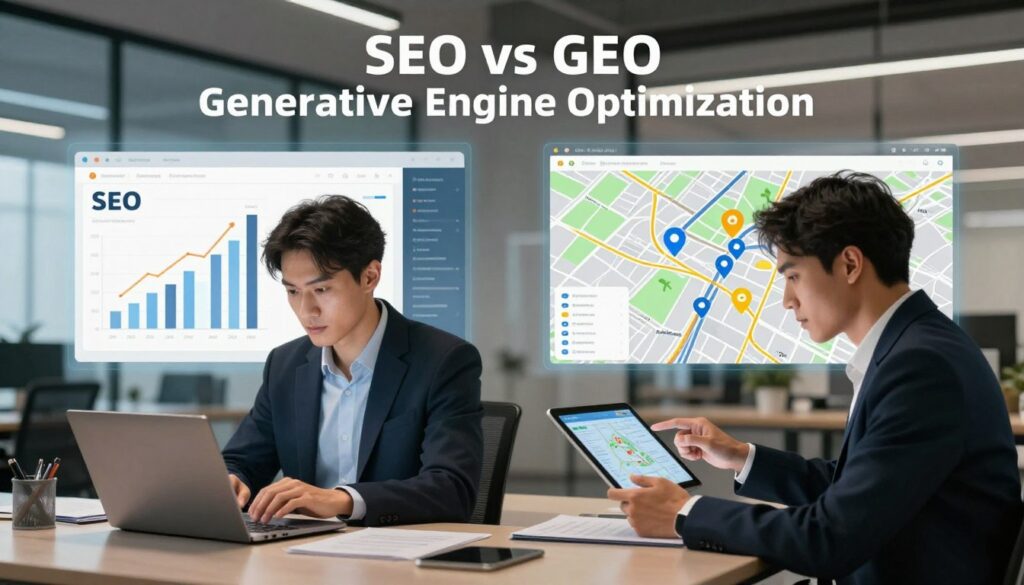
This change is a big deal in how people find what they need online. By getting good at both, you make sure your brand is a reliable voice in a digital world that’s getting more automated.
Key Takeaways
- The digital search landscape has evolved significantly by 2026.
- Balancing traditional search with AI-driven interfaces is essential for visibility.
- Modern marketers must adapt to new search behaviors to stay competitive.
- Understanding the nuances of generative engine optimization is a critical skill.
- Strategic alignment between SEO and GEO ensures long-term brand authority.
The Evolution of Search: From Traditional SEO to Generative Engine Optimization
Search has changed from a simple list of links to a deep conversation with smart machines. For years, search engine optimization helped connect users with the info they needed. But, our way of using the internet is changing, altering everything we know about finding things online.
The Shift in User Behavior
Today’s users don’t like the old “ten blue links” model. They want quick, clear answers without having to click through many sites. There’s a big demand for immediate, synthesized results that make things easy to understand.
This shift makes content creators rethink search engine optimization. People now ask questions in a way that feels like talking to a friend. They want the search engine to be a smart helper, not just a list of websites.
Why Search Engines Are Changing
Search engines must keep up with AI’s ability to give quick summaries. If they can’t provide direct answers, users will go elsewhere. This competition pushes search engines to use generative AI in their core functions.
By using these advanced models, search engines can understand complex questions better than old algorithms. This change is not just a trend; it’s a necessary evolution to meet today’s information needs. Good search engine optimization now means knowing how these machines work together to answer user queries.
Defining SEO: The Foundation of Search Visibility
Search engine optimization is key for any brand wanting to succeed online. The way search engines work hasn’t changed much, even as the internet evolves. Building a sustainable strategy means understanding these basics well.
Core Principles of On-Page SEO
Your website’s success starts with on-page seo. This focuses on what you can control. High-quality content is essential. It must meet user needs and offer real value.
Search engines favor pages that answer questions well. They look for clear and detailed answers.
Technical aspects are also important. Fast page loads, mobile friendliness, and good meta tags matter. A well-optimized site helps search engines index it better. This leads to better rankings and improved user experiences.
The Importance of Off-Page SEO and Backlinks
Off-page seo shows search engines your content is reliable and authoritative. Backlinks are like digital endorsements from other sites. A good backlink profile helps establish your site as a leader.
For local businesses, geo-targeted seo is a strong strategy. It helps you reach customers in your area. Combining off-page efforts with a solid on-page foundation drives growth.
Understanding GEO: The Rise of Generative Engine Optimization
The digital world is changing fast, moving towards a new search technology era. Generative engine optimization is a big shift in online visibility and content strategy. It’s different from old methods that matched keywords to static pages. Now, it’s about how machines create information to give direct, helpful answers.
How Generative AI Engines Process Queries
Today’s search engines are more like conversational partners than simple indexers. When you ask a question, they don’t just find blue links. They understand the intent behind your words.
These engines break down big questions into smaller parts. They then search vast datasets for the most relevant info. This way, they create a response that meets your specific needs right away.
The Mechanics of Large Language Models in Search
At the core of this change are Large Language Models (LLMs). These models are trained on huge amounts of text. They can recognize patterns and give the most accurate answers. Through generative engine optimization, content creators need to make sure their info is easy for these models to understand and trust.
The table below shows the main differences between old search methods and the new generative approach:
| Feature | Traditional SEO | Generative Search |
|---|---|---|
| Primary Goal | Ranking for keywords | Providing direct answers |
| Output Format | List of links | Synthesized summaries |
| User Interaction | Click-through | Conversational dialogue |
| Data Processing | Indexing static pages | Real-time pattern analysis |
To succeed, focus on clarity and authority. As generative engine optimization grows, creating high-quality, contextually aware content will be key.
Key Differences Between SEO and GEO: A Comparative Analysis
Digital visibility is more than just ranking. It’s about being understood by smart machines. Generative engine optimization adds a new layer of complexity. It changes how we create content.
Ranking Factors vs. Model Training Data
Old search engines use static ranking factors. These include keyword density and domain authority. They also look at the number of high-quality backlinks.
These signals help crawlers find and rank content. They look at relevance and popularity.
But, modern AI models work differently. They use probabilistic generation. They rely on lots of training data to create answers.
Your content needs to be easy for the model to understand. It should help form accurate, helpful answers.
Direct Answers vs. Link-Based Results
The search landscape has changed. Users now want direct, synthesized answers. They want answers that solve their problems without needing to click on multiple sites.
This change makes marketers rethink their goals. With generative engine optimization, you aim to be the main source of truth. You want to be the AI model’s go-to answer for users.
How Generative AI Models Change User Intent
We’re seeing a big change in how people search online. Now, users want answers that feel like they’re from a real person. This means marketers need to find new ways to connect with their audience.
Moving Beyond Keyword Matching
Old SEO methods often used the same keywords over and over. But now, AI looks at what the question really means, not just the words. This helps machines give answers that match what the user is looking for, even if they don’t use the exact right words.
Just using the same keywords won’t cut it anymore. Instead, focus on giving detailed answers that solve the user’s problem. This way, your content will match how AI understands information today.
The Rise of Conversational Search Queries
Short, simple searches are becoming a thing of the past. Now, people ask full questions and add more details later. This change makes old SEO tricks less useful.
To keep up, your content needs to be ready for these longer, more detailed questions. By answering these follow-up questions, you’re more likely to show up in AI summaries. Today, SEO is about giving the best, most detailed answers, not just using the right keywords.
Using these new SEO strategies will help your brand stay visible as search habits keep changing. By understanding the user’s needs, you build trust and authority in a world driven by AI.
Adapting Your Content Strategy for seo-vs-geo-generative-engine-optimization
The rise of generative engines changes how we share information online. Now, we focus on giving authoritative, clear, and context-rich answers. These answers are easy for AI to understand. Knowing the difference between seo-vs-geo-generative-engine-optimization is key to staying visible.

Creating Content for AI Comprehension
Your content needs to be written for machines. AI likes information that is straight to the point and organized. Use clear headings and short sentences to help AI find your page’s value fast.
Try to answer specific questions in your articles’ first few paragraphs. Giving definitive answers makes you a top source for AI summaries. This method works well with on-page seo to meet both human and AI needs.
Structuring Data for Machine Readability
The structure of your website is also important for AI. Using semantic HTML tags helps AI tell headers, lists, and body text apart. This is a key part of on-page seo today.
Adding structured data gives search engines more context. When you clearly define your content types, AI can categorize your info better. Here’s a table showing how content optimization has changed.
| Feature | Traditional SEO | Generative Engine Optimization |
|---|---|---|
| Primary Goal | Ranking for keywords | Providing direct answers |
| Content Style | Keyword-focused | Context-rich and logical |
| Success Metric | Click-through rate | Source citation frequency |
| Data Format | Standard HTML | Semantic and structured |
Technical Requirements for Modern Search Visibility
Technical infrastructure is key for both traditional search and AI discovery. A solid website foundation helps search engines understand your content better. This is essential for staying visible in today’s digital world.
Schema Markup and Structured Data
Schema markup is like a translator for your website and search engines. It uses structured data to explain your content, like products or local businesses. This semantic clarity helps AI models understand your site’s information better.
AI engines use these structured signals to give accurate answers. Adding schema is now a critical requirement for staying relevant in search results. It helps machines categorize your content well, increasing your chances of being in featured snippets.
Optimizing for Speed and Accessibility
Page speed and accessibility are must-haves for good performance. Users want fast loading times, and search algorithms favor quick sites. Slow pages can lose you both human visitors and search engine favor.
Accessibility makes your content usable by everyone, including those with assistive technologies. Clean code and easy navigation make your site better for all users. This focus on quality is key for geo-targeted seo, showing search engines your site is reliable and user-friendly.
Technical excellence supports your marketing goals. Combining structured data with a fast, accessible site makes it perform well in all search formats. Focus on these technical pillars to stay ahead in geo-targeted seo for the future.
The Role of Authority and Trust in Generative Results
AI models use certain signals to figure out which sources are trustworthy. As search gets more conversational, showing your brand’s reliability is key. Trust is the foundation for the answers AI gives to users.
Establishing E-E-A-T in the Age of AI
The E-E-A-T framework guides AI models. It stands for Experience, Expertise, Authoritativeness, and Trustworthiness. These systems look for content that shows deep knowledge. Demonstrating real-world experience makes your content stand out.
To do well, your content needs to be from verified authors. AI models check for patterns of quality information. This shows your brand is trustworthy.
“In the future of search, authority will not just be about how many links you have, but about the depth of the knowledge you provide and the trust you have earned from your audience.”
Citations and Source Attribution
Generative engines use data from various sources to give answers. Your off-page seo strategy is key here. Getting links from reputable sites is important. These links act as digital endorsements for AI models.
Good off-page seo is not just about ranking. It’s about being a trusted source for AI. Getting mentions in top publications helps your data get included in AI answers.
| Signal Type | Traditional SEO Focus | Generative AI Focus |
|---|---|---|
| Backlinks | Quantity and Anchor Text | Contextual Relevance and Trust |
| Content | Keyword Density | Factual Accuracy and Depth |
| Authority | Domain Rating | Expertise and Citations |
| User Data | Click-Through Rate | Information Verification |
Measuring Success in a Hybrid Search Environment
Success in 2026 means looking beyond simple clicks to understand your brand’s total footprint. As search results evolve, your seo strategies must adapt to capture data from both traditional links and generative AI summaries. Relying on a single metric is no longer enough to gauge your true digital impact.

Tracking Traditional Organic Traffic
Traditional organic traffic remains a vital indicator of your website’s health. You should continue to monitor click-through rates and keyword rankings within standard search engine results pages. These metrics provide a baseline for how well your content satisfies direct user queries.
Yet, you must refine your seo strategies to account for the “zero-click” phenomenon. When users find answers directly on the results page, your traffic might appear lower even if your brand visibility is high. Focus on tracking engagement metrics like time on page and conversion rates for the traffic that does reach your site.
Monitoring Brand Mentions and AI-Generated Summaries
The rise of generative AI requires a new approach to measuring brand authority. You need to track how often your brand appears within AI-generated summaries and conversational responses. This visibility is a critical indicator of your influence in the modern search ecosystem.
Implementing advanced sentiment analysis tools will help you understand how AI models describe your products or services. By refining your seo strategies to prioritize high-quality, factual content, you increase the likelihood of being cited as a trusted source. Regularly auditing these summaries ensures your brand maintains a positive and accurate presence in the eyes of the machine.
Ultimately, a holistic view of your performance combines traditional data with these new qualitative insights. By balancing these seo strategies, you can effectively navigate the complexities of a hybrid search environment. Stay agile, and keep adjusting your dashboards to reflect the changing ways users interact with your brand.
Common Pitfalls When Balancing SEO and GEO
Many marketers struggle when trying to use old SEO tactics in a new AI world. It’s tempting to keep using old seo techniques on new platforms. But, this often fails. You need to understand how both old search engines and new AI models see your content.
Over-Optimizing for Keywords
One big mistake is focusing too much on keyword optimization. When you only care about specific search terms, your content can sound fake. This makes it hard for both people and AI to enjoy.
Generative engines look for meaning and context, not just keywords. Too many keywords can make your text seem low-quality. Instead, aim for clear, complete answers that naturally include important topics.
Ignoring the User Experience
Technical tricks only go so far if your site isn’t user-friendly. Many teams get so caught up in ranking that they forget about the user. If your site is hard to use, people will leave fast.
High bounce rates tell search engines your content isn’t worth it, even if it’s well-optimized. Prioritizing the user means making your site fast, easy to get to, and simple to read on any device. This way, you create a strong presence that works in any search world.
The key is to find a balance between technical skills and caring about your audience. Don’t let algorithms control you. When you get this right, your brand will stay visible and trusted for a long time.
Future-Proofing Your Digital Marketing Strategy for 2026 and Beyond
To have a strong digital presence, you need more than just quick fixes. As we get closer to 2026, the search world is moving towards smarter, more interactive experiences. Creating solid seo strategies is now about building a lasting path for your brand to succeed in an ever-changing world.
Staying Agile with Algorithm Updates
Search engines are getting smarter with generative AI. To stay ahead, you must always be learning and adapting fast. Using old methods will hurt your visibility as algorithms focus more on what users want, not just keywords.
Being agile means watching how people use new AI tools. When you see changes in traffic, update your content quickly. Good seo strategies see every algorithm change as a chance to get better and serve users better.
Investing in Brand Equity
In a world where AI answers questions fast, your brand is your greatest asset. People want reliable sources that show they know their stuff. By focusing on E-E-A-T, your content stays top choice for both people and AI.
Building a strong reputation creates a barrier for your business that rivals can’t easily cross. Creating valuable content that solves problems builds loyalty and gets you mentioned online. These seo strategies make your brand a top result for years to come.
| Strategy Focus | Short-Term Impact | Long-Term Benefit |
|---|---|---|
| Content Quality | Quick traffic spikes | Lasting brand authority |
| Technical Setup | Immediate indexing | Improved site stability |
| User Engagement | Higher click rates | Increased customer trust |
| AI Adaptation | Better snippet visibility | Future-proofed relevance |
Conclusion
The digital world is changing fast. Search engines are now more than just directories. They’re smart machines that give answers.
To succeed, you need to mix old search tricks with new AI strategies. It’s all about understanding what people want and making your data easy for algorithms to read.
Brands that offer clear, reliable, and organized info will do well. Google and OpenAI are changing how we find things online. How you adjust your digital plan will decide if you stay visible.
Start checking your content to see if it’s easy for machines to read. Share valuable insights that answer real questions. Being quick to adapt will keep your brand ahead in the tech race.
FAQ
What is the primary difference between SEO and GEO?
SEO focuses on ranking your website in search engine results. On the other hand, GEO aims to make your content directly answerable by AI models. SEO is about getting a click, while GEO is about being mentioned in an AI’s response.
How is keyword optimization changing in 2026?
Keyword optimization is moving from exact phrases to understanding user intent. Modern SEO focuses on semantic relevance and natural language. Businesses now need to optimize for conversational queries to meet the needs of AI models.
Is geo-targeted seo important for local businesses?
Yes, it’s more important than ever! Geo-targeted SEO helps local businesses get found. AI assistants use structured data and local citations to give answers based on location. Keeping your local signals high can make you a top choice in AI-driven searches.
What are the most effective seo strategies for balancing both SEO and GEO?
The best strategies today are a mix of old and new. Keep up with on-page SEO basics like quality content and technical health. Also, use Schema markup and structured data to make your content readable by AI models.
How do generative AI engines process search queries differently than traditional bots?
Traditional bots match pages to keywords. Generative AI models analyze data to understand the “why” behind a query. They synthesize information to give unique, real-time answers that address the user’s context.
Why is off-page seo important for AI-driven search?
Off-page SEO is key because AI models trust and authority. Getting high-quality backlinks and mentions on reputable sites shows your brand’s reliability. This makes your site more likely to be cited by AI when answering questions.
What technical seo techniques should I prioritize for 2026?
Focus on technical SEO that improves machine understanding. Use JSON-LD Schema, ensure fast mobile load speeds, and have a clear site hierarchy. These steps help both search crawlers and AI models navigate your site better.
How do I measure success when search results no longer always lead to a click?
Success in a hybrid environment means looking beyond clicks. Monitor clicks, but also track brand mentions, sentiment, and “share of voice” in AI summaries. Tools that analyze AI citations are key to understanding your digital footprint.
What is a common pitfall to avoid when adapting to GEO?
Avoid focusing too much on AI at the expense of human experience. If your content feels robotic, it won’t be trustworthy. Successful brands in 2026 will provide clear, authoritative, and helpful content for both humans and AI models.